AI Leverage 2026: From Endurance to Leverage in Humanitarian Work
2025 was heavy. If you spent the year reading PDFs at midnight, rewriting the same brief for a fourth donor, and watching your funding shrink while expectations grew, you are not alone. The pressure was not just harder. It was denser.
This guide is a working summary of the 2026 AI Leverage Shift, a HumGPT thesis built for humanitarian and development professionals who are ready to stop carrying the cognitive burden alone. The shift is not about working faster. It is about working clearer.
Why 2025 broke so many analysts
The challenge in 2025 was never complexity. It was density. The same job had more documents, more evidence, more stakeholders, and more pressure to convert information into decisions on a tighter clock.
- Funding tightened across most response plans.
- Deadlines shortened while reporting volume grew.
- Expectations rose, but capacity did not.
- Teams were asked to do strategic work without strategic time.
Most of the load fell on the analytical layer of the sector. The people who read the 200-page IPC reports. The people who synthesize cluster updates into a 2-page brief on Friday afternoon. The people who hold the line on rigor while the politics of the funding cycle compress the timeline.
The shift: AI as a support system for thinking, not a shortcut
The 2026 leverage shift is built around one principle. AI replaces friction. It does not replace judgment.
Used responsibly, AI becomes a support system for thinking, not a shortcut around it.
From the 2026 AI Leverage thesis
The friction it replaces is the time between reading and structuring. That is the slow, expensive layer of analytical work. The layer where most professionals lose hours to copy-paste, skim-and-search, and second-guessing their own notes.
What stays human:
- Judgment. Whether a draft is true, useful, and safe to send.
- Context. What the field knows that the documents do not say.
- Principles. Humanity, neutrality, impartiality, independence, and Do No Harm.
From endurance to leverage
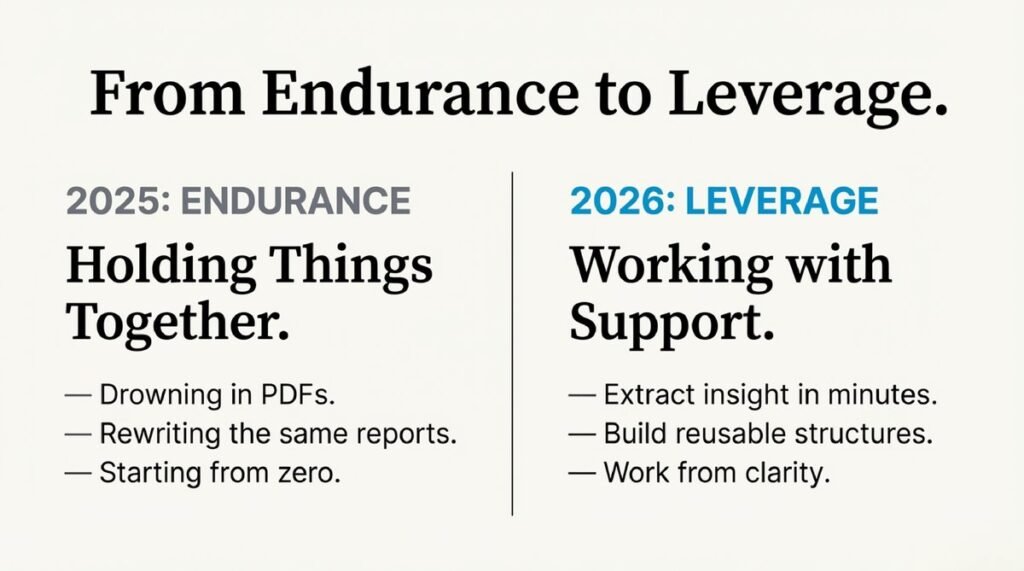
The mental model from the thesis is a clear one. 2025 was endurance. 2026 is leverage.
2025: endurance
- Drowning in PDFs.
- Rewriting the same reports.
- Starting from zero on every new brief.
- Holding things together by personal effort.
2026: leverage
- Extract insight in minutes, not days.
- Build reusable structures across countries and themes.
- Work from clarity, not from a blank page.
- Direct AI like a junior analyst with infinite typing speed.
Four skills that define professional leverage
The thesis names four operating skills that separate professionals who use AI as a workflow from those who chat with it. These are the skills the HumGPT course teaches in detail. Here is the short version.
- Synthesize information across sources. Combine data from multiple inputs into one coherent analysis without losing the source thread.
- Translate complexity into clear narratives. Compress 200 pages into a 2-page brief without flattening the nuance.
- Produce decision-ready briefs and presentations. Move from analysis to deliverable in the same working session.
- Protect cognitive energy for judgment and ethics. Reserve mental bandwidth for the calls that only a human can make.
The goal is not working faster, it is working clearer
Professionals who shift to leverage describe the same thing. The work does not just speed up. It loosens. The fog between reading and writing thins. The brain stops fighting the format and starts focusing on the call.
That is where AI, used well, creates space rather than stress. It turns evidence into insight without losing rigor.
How to start this week
Three steps to put the shift into practice on real work, not theory.
- Pick one repeating deliverable. A weekly SitRep, a monthly brief, a quarterly risk update. Define the structure on paper before you open any AI tool.
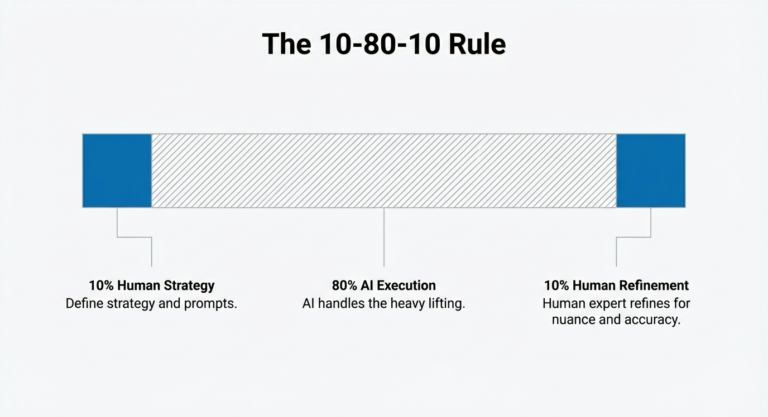
- Run the structure through the 10-80-10 method. Ten percent thinking and prompting, eighty percent generation, ten percent validation. See the 10-80-10 rule explained.
- Compare your first AI-assisted version to the version you would have written by hand. Where did it save time? Where did it lose nuance? Adjust the workflow and run it again next week.
Most professionals save a full work day on the first real deliverable after going through one structured workflow. The biggest gains are on repeatable formats.
Closing thought
You do not need to do everything alone anymore.
From the 2026 AI Leverage thesis
This is a commitment to share how professionals can thoughtfully integrate AI into daily workflows without compromising quality, principles, or purpose. The course goes deeper on every skill above. The blog and YouTube channel keep the practice fresh.
Continue reading
- The 10-80-10 rule: how professionals use generative AI
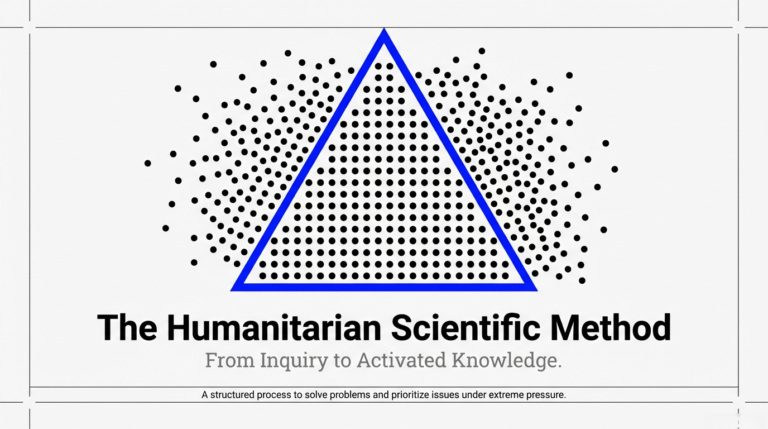
- The humanitarian scientific method: from inquiry to activated knowledge
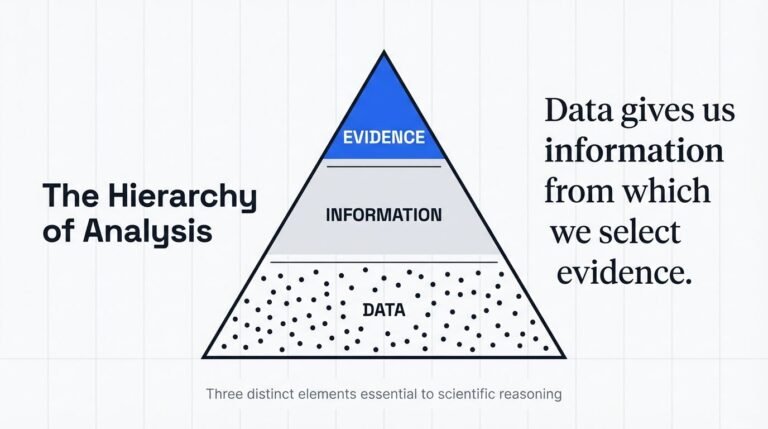
- Data, information, evidence: the architecture of analytical proof
Want the full system? The HumGPT course teaches the same workflows on real humanitarian deliverables: SitReps, donor briefs, country risk profiles, secondary data reviews, and more.
$39 (was $197). Lifetime access. 14-day money-back guarantee. Enroll in HumGPT.
Frequently asked questions
What is AI leverage in humanitarian work?
AI leverage is the practice of using AI to replace the friction between reading and structuring analytical work. It frees the analyst’s cognitive energy for judgment, context, and ethics. It is not a shortcut. It is a support system for thinking.
How is 2026 different from 2025?
2025 was about endurance — holding things together as funding tightened, deadlines shortened, and reporting volume grew. 2026 is about leverage — working from clarity, building reusable structures, and using AI to extract insight in minutes.
Will AI replace humanitarian analysts?
No. AI replaces the typing speed and the search-and-copy steps. The judgment, the context, and the ethical calls stay with the analyst. The 10-80-10 method makes the split explicit.
Do I need a paid AI subscription?
Most workflows in the HumGPT course can be done on free tiers of ChatGPT, Claude, NotebookLM, and Perplexity. A paid subscription helps for long-context work but is not required to start.
Where do I start?
Pick one weekly or monthly deliverable you already produce. Define its structure on paper. Run it through the 10-80-10 method. Compare the result to your hand-written version. The first iteration is the most informative.