Sudan INFORM Risk Profile 2025: A Country Case Study
Sudan ranks 5 of 191 countries on the INFORM Risk Index mid-2025. The overall score of 7.9 places it in the Very High Risk category, tied with Afghanistan and Congo DR, surpassed only by South Sudan and Chad.
This post is a working summary of a Sudan country risk profile analysis. It walks through the INFORM model, the primary risk drivers, the vulnerability profile, the coping capacity gaps, and the regional context. It is a case study in how to build a country risk profile that holds up to senior review.
Executive dashboard
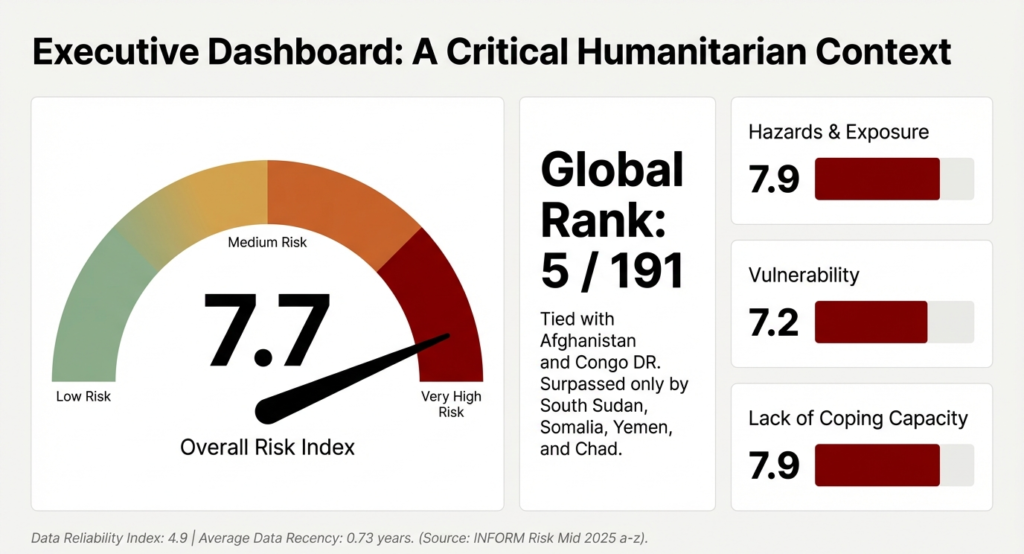
Global Rank: 5 of 191
Hazards & Exposure: 7.7
Vulnerability: 7.2
Lack of Coping Capacity: 7.9
Data Reliability Index: 4.9
Average Data Recency: 0.73 years
Source: INFORM Risk Mid 2025 v0.7.1, Release 31 August 2025.
The INFORM model
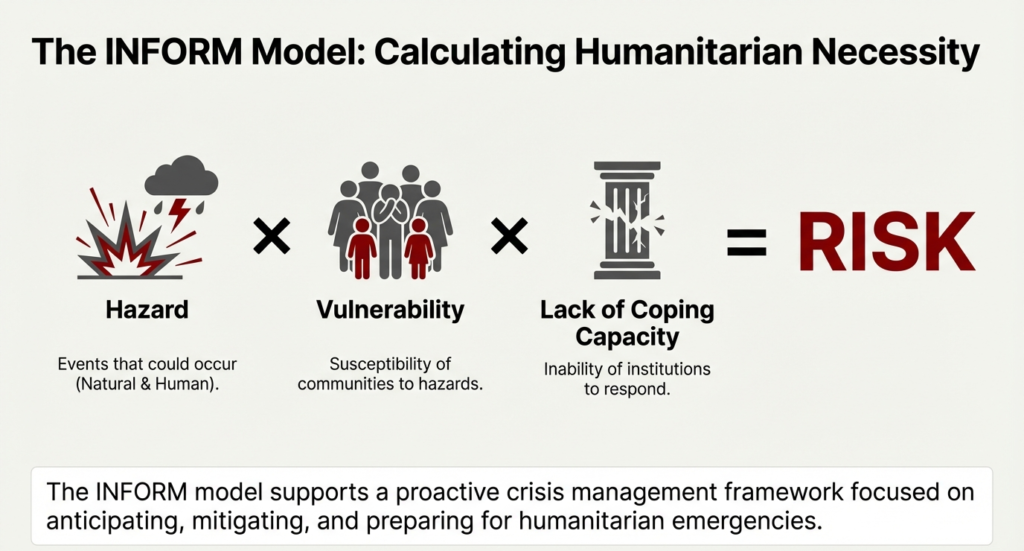
INFORM is a global risk index supporting proactive crisis management. The model multiplies three dimensions:
- Hazard. Events that could occur (natural and human-induced).
- Vulnerability. Susceptibility of communities to hazards.
- Lack of Coping Capacity. Inability of institutions to respond.
Together, these dimensions estimate humanitarian necessity — the gap between what could happen and what local systems can absorb.
Hazards and exposure: dominated by human conflict
Sudan’s hazard profile is skewed heavily by human-induced instability.
- Human Hazard score: 9.6 (near-total saturation of conflict indicators).
- Natural Hazard score: significantly lower.
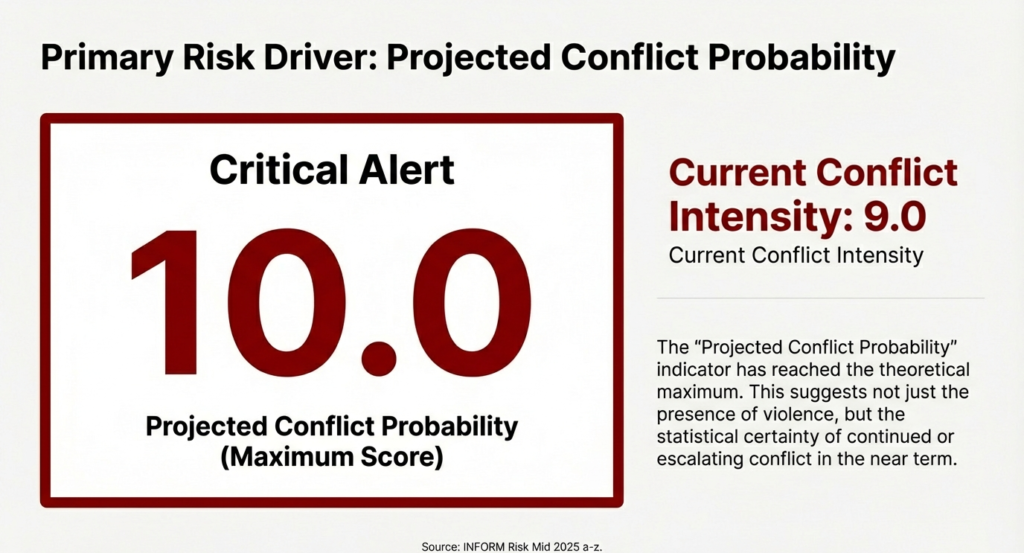
Primary risk driver: projected conflict probability
Current Conflict Intensity: 9.0
Projected Conflict Probability: maximum score (theoretical ceiling).
This suggests not just current conflict but a statistical certainty of continued and escalating conflict in the near term.
Secondary risk driver: riverine flood exposure
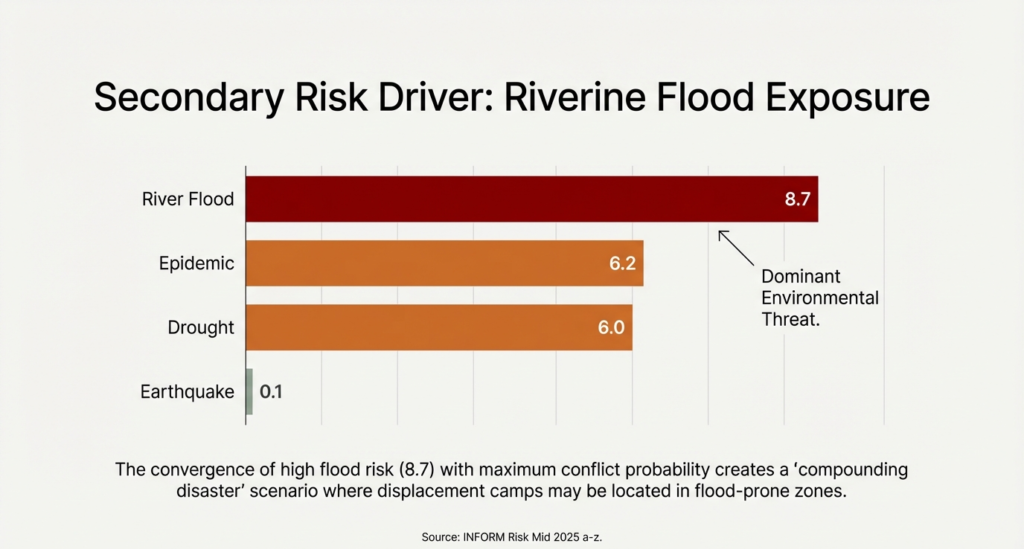
- River flood: 8.7 (dominant environmental threat).
- Drought: 6.0.
- Epidemic: elevated.
- Earthquake: 0.1 (negligible).
The convergence of maximum conflict probability with high flood risk creates a compounding disaster scenario where displacement camps may be located in flood-prone zones.
Vulnerability: fragile groups in a fragile state
The aggregate Vulnerability score of 7.2 is driven less by general economic dependency and more by the specific, acute deprivation of targeted population groups.
- Socio-Economic Vulnerability: 6.0.
- Vulnerable Groups: 8.5.
Critical failure point: uprooted people
- Development & Deprivation: 8.5.
- Health Conditions: 1.4.
- Uprooted People indicator: at the maximum limit.
The Uprooted People indicator at maximum reflects a population that has already exhausted its coping mechanisms through displacement, making them hyper-susceptible to any new hazard.
Coping capacity: systemic governance gaps
Overall Lack of Coping Capacity: 7.9 (Very High)
- Institutional: 8.4 — severe weakness in administrative apparatus.
- Infrastructure: 7.2 — physical limitations in transport and connectivity.
A score of 8.4 in the Institutional category suggests a near-total breakdown in the government’s ability to organize relief.
Barriers to humanitarian response
- Governance (8.8): critical bottleneck. Diplomatic and logistical barriers to aid distribution.
- Communication (7.0): severe constraint.
- Physical Infrastructure (7.0): severe constraint.
- Health Care (8.0): failure — the system cannot handle a major event.
Regional context: a contiguous belt of instability
Sudan sits between the #1 and #4 highest-risk countries in the world.
- South Sudan: 8.3 (rank 1 globally).
- Sudan: 7.9 (rank 5 globally).
- Chad: 7.8 (rank 4 globally).
- Ethiopia: 6.9 (rank 13 globally).
- Libya: 4.7.
- Egypt: 4.3.
This implies significant cross-border spillover risks, including refugee flows and arms trafficking. The Sudan conflict is exporting humanitarian risk to the surrounding region.
Risk profile synthesis: the balanced crisis
The defining feature of Sudan’s risk profile is a systemic collapse pattern. High scores across all three dimensions of the INFORM model indicate that no strong pillar supports the others.
- Hazard: 7.7
- Vulnerability: 7.2
- Lack of Coping Capacity: 7.9
Unlike countries where a single dimension drives risk and the others can absorb some shock, Sudan’s risk is balanced and high across the entire model. There is no internal buffer.
How this maps to the analytical method
This country risk profile is a worked example of the decision-ready stack:
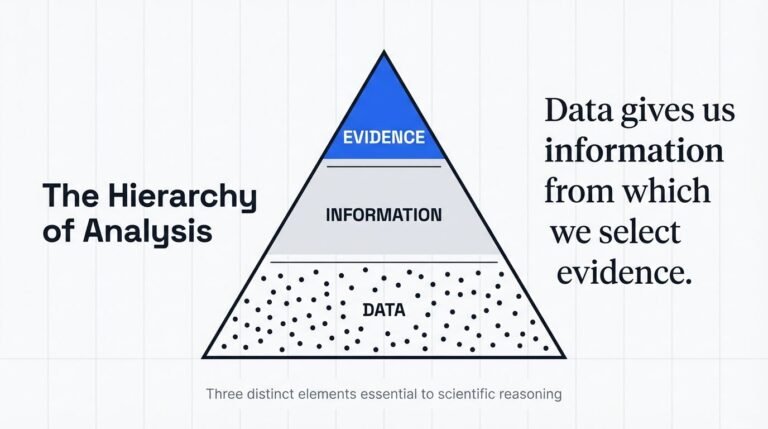
- Pyramid Principle: Overall risk and rank lead. Reasons follow. Evidence supports.
- MECE: Hazard, vulnerability, coping capacity cover the full INFORM model without overlap.
- Intellectual standards: The data recency (0.73 years) and reliability index (4.9) are stated explicitly to allow the reader to weigh confidence.
- Anomaly check: The 1.4 score for Health Conditions in a Vulnerable Groups category of 8.5 is flagged — an anomaly that warrants further investigation.
Continue reading
- The 2026 Resilience Reset: anticipatory action for the Horn of Africa
- Uganda displacement and resilience 2025
- The humanitarian scientific method
Want the full system? The HumGPT course teaches the same workflows on real humanitarian deliverables: SitReps, donor briefs, country risk profiles, secondary data reviews, and more.
$39 (was $197). Lifetime access. 14-day money-back guarantee. Enroll in HumGPT.
Frequently asked questions
What is the INFORM Risk Index?
INFORM is a global risk index for humanitarian crises. It multiplies Hazard & Exposure, Vulnerability, and Lack of Coping Capacity into a single 0-10 score. It supports proactive crisis management by estimating the gap between what could happen and what local systems can absorb.
Where does Sudan rank in 2025?
Sudan ranks 5 of 191 countries on the INFORM Risk Index mid-2025, with an overall score of 7.9. It is tied with Afghanistan and Congo DR, surpassed only by South Sudan (rank 1) and Chad (rank 4).
What drives Sudan’s risk profile?
Maximum conflict probability is the primary driver. Riverine flood exposure (8.7) is the secondary driver. Vulnerable groups (8.5) and uprooted people (at maximum) drive the vulnerability dimension. Institutional collapse (8.4) drives the lack of coping capacity dimension.
What does “balanced crisis” mean for Sudan?
Sudan’s risk is high across all three INFORM dimensions simultaneously. Unlike countries where one dimension drives risk and the others provide some buffer, Sudan has no strong pillar supporting the others. This is the systemic collapse pattern.
How current is this data?
The INFORM Risk Mid 2025 v0.7.1 dataset was released 31 August 2025. Average data recency is 0.73 years across indicators. Data Reliability Index is 4.9. Both should be stated in any brief built from this dataset so readers can weigh confidence.