The Humanitarian Scientific Method: From Inquiry to Activated Knowledge
In a humanitarian crisis, the urge to act leads to hasty decisions. Without a structured process, conclusions are often incorrect or biased. The scientific method, adapted for humanitarian work, replaces intuition with rigorous inquiry.
This guide is a working summary of the HumGPT Humanitarian Scientific Method. It is the analytical engine behind every deliverable a serious analyst produces: country risk profiles, food security analyses, displacement syntheses, and donor briefs that hold up under senior review.
The three phases of the loop
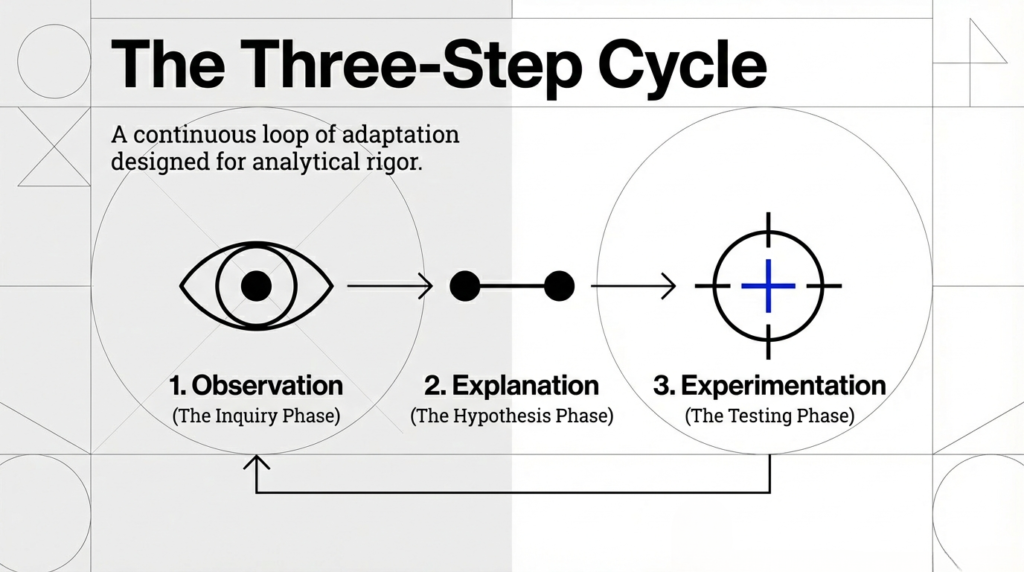
The Humanitarian Scientific Method is a continuous loop of adaptation designed for analytical rigor. It has three phases:
- Observation (the inquiry phase). Establish the facts. Identify the phenomenon. Separate fact from assumption. Spot anomalies.
- Explanation (the hypothesis phase). Move from what to why. Form a tentative insight explaining how events connect. Test for cause versus correlation.
- Experimentation (the testing phase). Try to falsify the hypothesis. If observations contradict it, refine or start over. Only if it survives scrutiny is it corroborated.
Each phase has its own discipline. Skipping any one of them is how analysts produce briefs that fall apart under questioning.
Step 1: Establish the facts (observation)
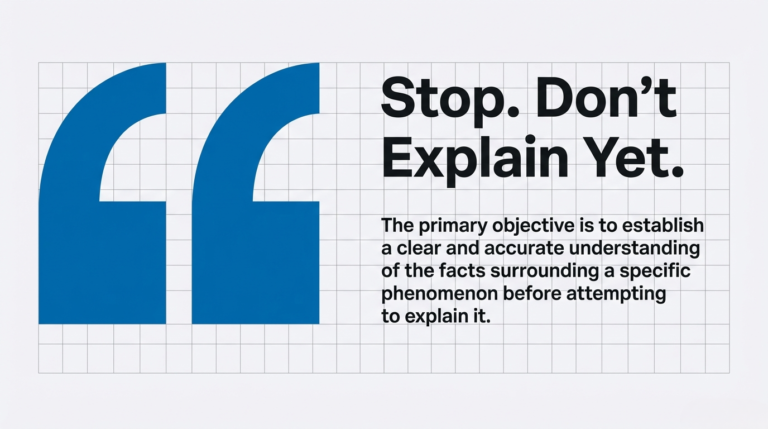
Stop. Do not explain yet. The primary objective is a clear, accurate understanding of the facts surrounding a specific phenomenon before attempting to explain it.
Three analytical actions:
- Identify the phenomenon. Carefully observe a specific part of the crisis context. Gather data rigorously so no relevant information is overlooked.
- Separate fact from assumption. Distinguish what is definitively known from what is merely believed. Be vigilant against “loaded questions” that contain embedded assumptions.
- Spot anomalies. Look for data that does not fit accepted understanding. The reaction “hang on, this cannot be right” points to fruitful areas for investigation.
Anomalies are valuable. They contradict accepted knowledge. They are where the next insight lives. See the dedicated guide on observation groundwork.
Step 2: Move from what to why (explanation)
A hypothesis is a tentative insight explaining how events connect. It is an unproven idea used to explain a phenomenon.
Example. If an earthquake-affected population learns about building standards, it is probable they will rebuild houses that are resilient.
Is it causal or correlated?
Analysts must use logic to link events. Apply three criteria to determine if cause A triggers effect B:
- Temporal sequence. The cause must strictly precede the effect.
- Consistency. The relationship is replicated in different settings.
- Rational basis. There is a logical reason for the conclusion.
Without all three, you have correlation, not causation. Acting on correlation in a humanitarian context can misdirect resources and harm the people you are trying to serve.
Step 3: Shoot down the idea (experimentation)
Science is not about proving a specific truth, but about trying to falsify hypotheses.
From the Humanitarian Scientific Method
If observations contradict the idea, you must start over or refine the explanation. Only if it survives scrutiny is it corroborated.
Validation methods
- Corroboration. New evidence supports the hypothesis. It is not “proven” in a final sense. It is supported enough to proceed.
- Control groups. Compare the situation against a similar group not exposed to the specific factor. This ensures the effect actually arose from the expected cause.
The nine intellectual standards
To execute the scientific method effectively, analysts must apply intellectual standards to their reasoning. These standards act as quality control for every piece of data.
| Standard | Question to ask |
|---|---|
| Clarity | Is it understandable? |
| Accuracy | Is it free from error and bias? |
| Precision | Is the detail sufficient? |
| Relevance | Does it relate to the problem? |
| Depth | Does it address complexities? |
| Breadth | Does it encompass multiple viewpoints? |
| Logic | Do all parts make sense together? |
| Significance | Does it focus on priority needs? |
| Fairness | Is it justifiable and not self-serving? |
The hierarchy of value: from data to activated knowledge
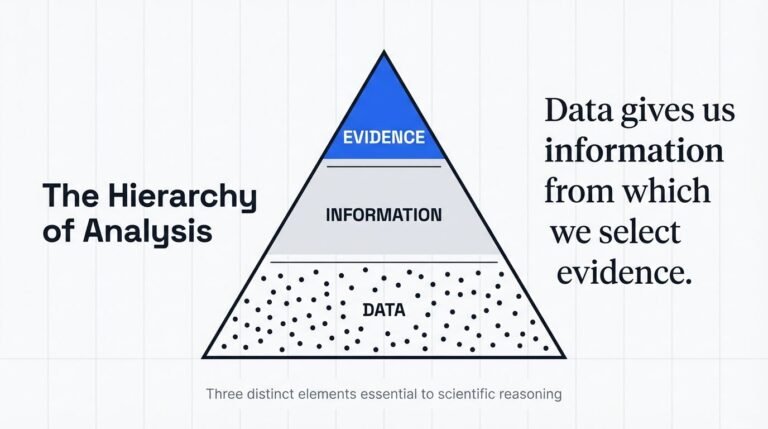
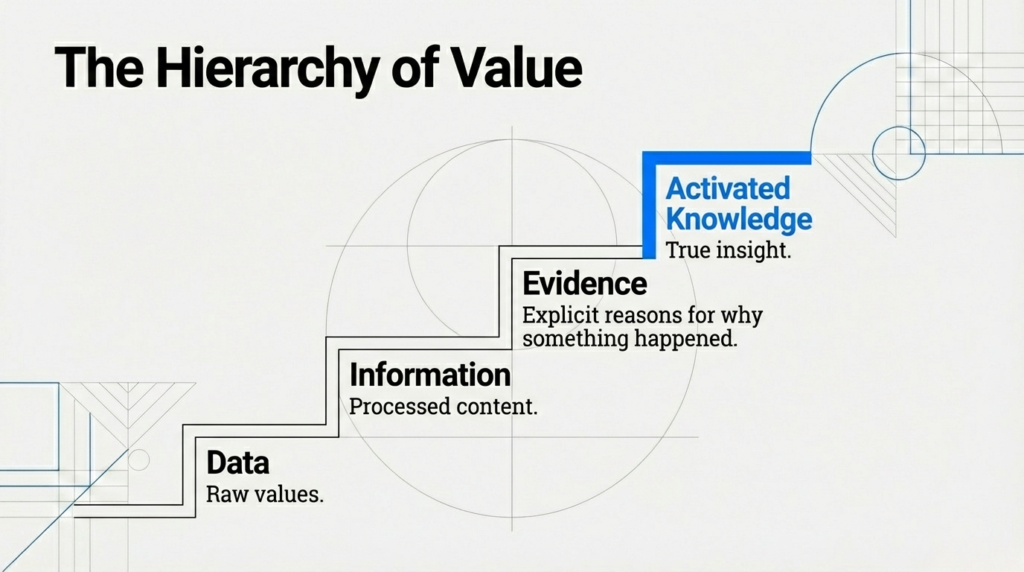
The scientific method climbs four levels:
- Data. Raw values.
- Information. Processed content.
- Evidence. Explicit reasons for why something happened.
- Activated knowledge. True insight that leads to better decisions in crises.
Activated knowledge is the goal. It is knowledge that is understood, not just memorized. When knowledge is activated, it produces further insight and better decision-making under crisis pressure.
Putting it into practice this week
- Pick a current analytical question. A risk you are profiling, a trend you are watching, a contradiction in the cluster data.
- Run step 1 (observation). Write down what you know for sure, what you assume, and where the anomalies are.
- Run step 2 (explanation). Form one or two hypotheses. Apply the three criteria for causality.
- Run step 3 (experimentation). Try to falsify the hypothesis. Use control comparisons where possible.
- Audit against the nine standards. Mark the weakest standard and strengthen it before sending the brief.
Analyze better. Act faster.
The Humanitarian Scientific Method
Continue reading
- Observation groundwork: where rigorous analysis begins
- Data, information, evidence: the architecture of proof
- From evidence to decision: frameworks for humanitarian analysts
Want the full system? The HumGPT course teaches the same workflows on real humanitarian deliverables: SitReps, donor briefs, country risk profiles, secondary data reviews, and more.
$39 (was $197). Lifetime access. 14-day money-back guarantee. Enroll in HumGPT.
Frequently asked questions
What is the humanitarian scientific method?
The humanitarian scientific method is a three-phase loop — observation, explanation, experimentation — adapted for humanitarian analysts working under crisis pressure. It replaces intuition with structured inquiry.
Why do humanitarian analysts need a scientific method?
Crisis pressure rewards hasty conclusions. Without a structured process, biases and assumptions creep into briefs that influence funding, prioritization, and protection decisions. The scientific method is the discipline that prevents this.
What is activated knowledge?
Activated knowledge is true insight — knowledge that is understood, not just memorized. It leads to further insight and better decision-making. It is the top of the four-level hierarchy: data, information, evidence, activated knowledge.
How do I apply the nine intellectual standards?
After drafting any analysis, audit it against the nine standards: clarity, accuracy, precision, relevance, depth, breadth, logic, significance, fairness. Identify the weakest standard and strengthen it before sending.
Where does AI fit in the scientific method?
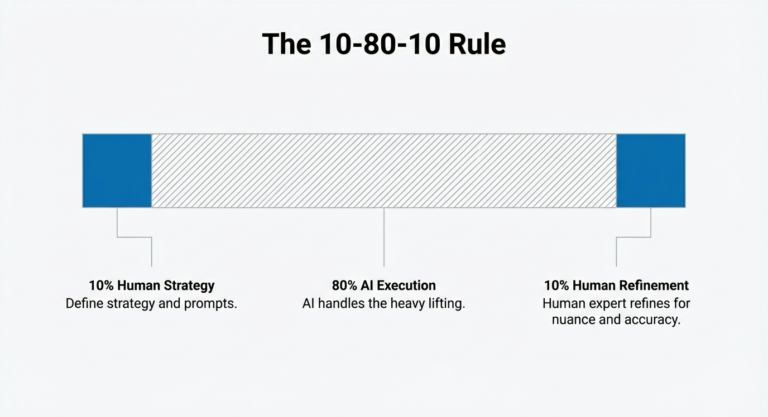
AI accelerates the data-to-information step and helps surface anomalies in long documents. The hypothesis formation, the falsification testing, and the judgment of what counts as evidence stay with the analyst.