The 10-80-10 Rule: How Professionals Use Generative AI for Humanitarian Work
Most people use AI as a chat tool. They paste a prompt, they pray, they patch the output. The result feels generic and the time saved is marginal.
Professionals use AI as a workflow. The 10-80-10 rule is the structure of that workflow. It is the operating method behind the HumGPT course and the foundation for every deliverable a humanitarian or M&E professional produces: SitReps, donor briefs, country risk profiles, secondary data reviews, drought analyses, food security syntheses.
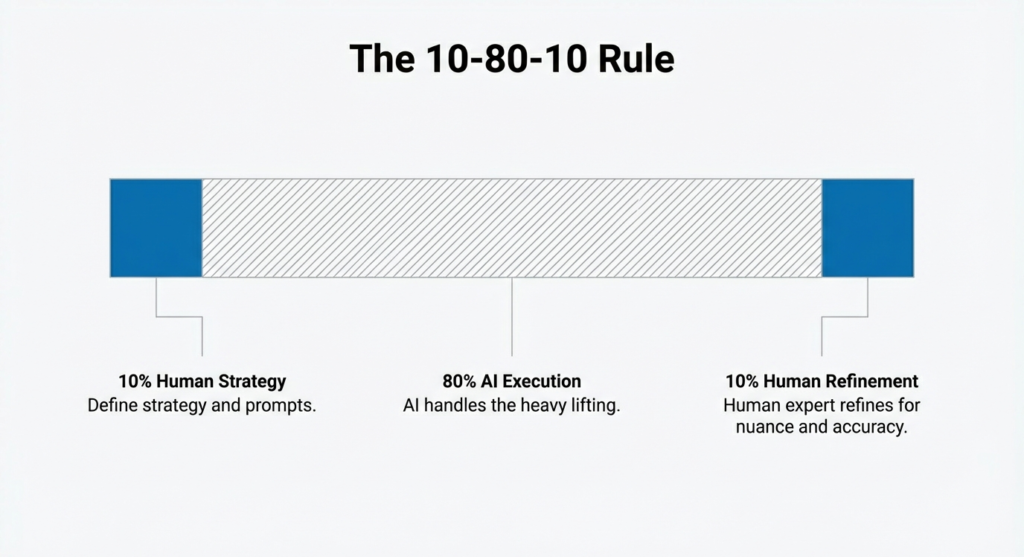
The split, in one minute
- 10% thinking and prompting. You frame the question, the audience, the constraints, and the figures that must be cited. This is the highest-leverage part of the work.
- 80% generation. AI does the grinding. It scans long PDFs, drafts the structural skeleton, synthesizes evidence, and produces first drafts of briefs, slides, and infographics.
- 10% refinement and validation. You apply professional judgment. You verify figures against source. You catch tone, framing, and ethical issues before publication.
You stay in control. AI does the volume. Your judgment is the final layer.
The first 10%: thinking and prompting
This is where the strongest analysts spend their energy. Not on the typing. On the framing.
A good first-10% deliverable answers six questions before you open any AI tool:
- Who is the audience? A country director and a donor focal point read differently.
- What is the format? Two pages, six slides, or a 600-word inbox brief.
- What is the timeframe? Reporting period, validity window, sensitivity window.
- What figures are non-negotiable? The numbers that must be cited inline.
- What is the Do No Harm boundary? Names, sites, GPS, sensitive populations.
- What is the call to action? Approve, fund, escalate, redesign.
The first 10% is also where you brainstorm. Brainstorm the angle. Brainstorm the structure. Draft the key messages. The clearer this layer, the faster the next 80% lands.
The middle 80%: AI generates the bulk of the content
With a clean first 10%, the model has enough to produce a structured first draft. This is where the time savings show up.
Four common tasks in the 80%:
- Extraction. Pull the headline figures, dates, and locations from long PDFs. NotebookLM handles this well with page-level citations.
- Synthesis. Combine extracts from multiple sources into a coherent analysis. Cross-document synthesis is where AI saves the most time.
- Drafting. Produce the first version of the brief, the SitRep, the slide outline, the infographic copy.
- Reformatting. Convert a long-form analysis into a 2-page brief or a 6-slide deck.
The model does not need to be perfect. It needs to be 80 to 90 percent ready. Your job in the next step is to bring it the rest of the way.
The final 10%: humanize, edit, and fact-check
This is the hardest part of the workflow. Skipping it is what gives AI-assisted work a bad reputation.
Four non-negotiables in the final 10%:
- Humanize the content. Strip generic AI tone. Words like “leverage”, “harness”, “navigate”, “rapidly evolving landscape”, and “unlock” should not appear in a humanitarian brief. Replace them with restrained, declarative language.
- Edit for structure. Does the headline fact land first? Are the figures ordered by donor relevance? Is the recommended action specific and time-bound?
- Fact-check rigorously. Every figure in the draft must be verified against the source document. Hallucinated numbers are the highest-cost error in humanitarian work.
- Apply the Do No Harm check. No PII. No exact site names. No language that could compromise the people you are reporting on.
The final 10 percent is the hardest part. It is where the analyst earns the right to send the brief.
From the HumGPT 10-80-10 method
Why the split works
The 10-80-10 rule mirrors how senior analysts have always worked. A country director does not write a 2-page brief by hand. They direct a team. The team gathers, drafts, and structures. The director frames the question at the start and validates the output at the end.
In the 10-80-10 method, the team is AI. The director is you.
That framing matters for three reasons:
- It preserves accountability. You stay responsible for the final product.
- It reduces hallucination risk. You feed clean inputs and verify outputs.
- It scales across deliverables. The same split works for SitReps, donor briefs, country risk profiles, drought analyses, and food security syntheses.
The 10-80-10 method across humanitarian deliverables
| Deliverable | What you do (10% + 10%) | What AI does (80%) |
|---|---|---|
| SitRep | Frame priorities, validate figures, set the message. | Pull figures, draft the situational overview. |
| Donor brief | Confirm donor framing, check sensitivities. | Synthesize evidence, draft narrative and recommendations. |
| Country risk profile | Weight risks, apply context, sign off. | Structure the analysis, draft each risk category. |
| Drought analysis | Validate against field knowledge. | Extract data across reports, build the trend story. |
Common mistakes to avoid
- Skipping the first 10%. Vague prompts produce vague drafts. The model fills the gap with generic language.
- Inflating the middle 80%. Asking AI to do work that requires judgment, context, or ethical calls.
- Shortcutting the final 10%. Sending a draft you have not verified against source.
- Pasting PII into public AI tools. Names, exact ages, GPS coordinates, and protection details do not belong in a free ChatGPT or Claude session.
Continue reading
- AI leverage 2026: from endurance to leverage
- The humanitarian scientific method
- From evidence to decision: frameworks for humanitarian analysts
Want the full system? The HumGPT course teaches the same workflows on real humanitarian deliverables: SitReps, donor briefs, country risk profiles, secondary data reviews, and more.
$39 (was $197). Lifetime access. 14-day money-back guarantee. Enroll in HumGPT.
Frequently asked questions
What is the 10-80-10 rule?
The 10-80-10 rule is a workflow split for using generative AI on professional analytical work. Ten percent of effort goes to thinking and prompting, eighty percent to AI generation, and the final ten percent to refinement and validation. It is the method taught inside the HumGPT course.
Why not 20-60-20 or 5-90-5?
The 10-80-10 split is calibrated for humanitarian rigor. The first ten percent is the smallest amount of upfront thinking that still gives the model enough to produce a usable draft. The final ten percent is the smallest amount of validation that still catches hallucinated figures and tone issues.
Does 10-80-10 work across every AI tool?
Yes. The method is tool-agnostic. It works with ChatGPT, Claude, Gemini, NotebookLM, Perplexity, and any future generative AI tool. The framework is the workflow layer, not the tool layer.
Can I use 10-80-10 on sensitive data?
Apply Do No Harm rules in the first 10%. Decide what data is safe to pass into a public AI tool and what must go through an enterprise or local AI environment. The 10-80-10 method does not override organizational data policy.
How long until I see results?
Most professionals save a full work day on the first deliverable they run through the 10-80-10 method. The biggest gains are on weekly or monthly repeatable formats.