Observation Groundwork: Where Rigorous Humanitarian Analysis Begins
Stop. Do not explain yet.
That is the discipline of the observation phase. Before you analyze why a humanitarian situation and is changing, you have to establish a clear and accurate understanding of the facts surrounding the phenomenon. Skipping this step is the most common reason analytical briefs fall apart under senior review.
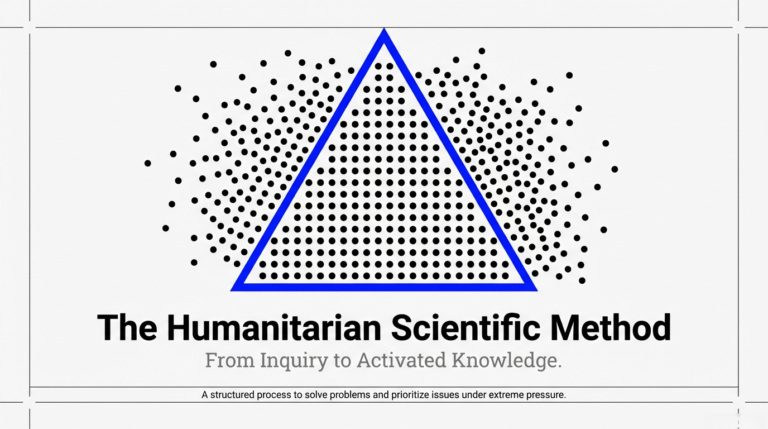
This guide walks through the three analytical actions that build the inquiry phase. It is the first step of the Humanitarian Scientific Method and the foundation for every hypothesis and decision that follows.
Why observation comes first
In a humanitarian crisis, the urge to explain is immediate. A donor asks why food insecurity is spiking. A cluster lead asks why displacement is increasing. A senior advisor asks why coverage is dropping.
Strong analysts resist that urge. They establish the facts first.
The primary objective is to establish a clear and accurate understanding of the facts surrounding a specific phenomenon before attempting to explain it.
From the Observation Groundwork guide
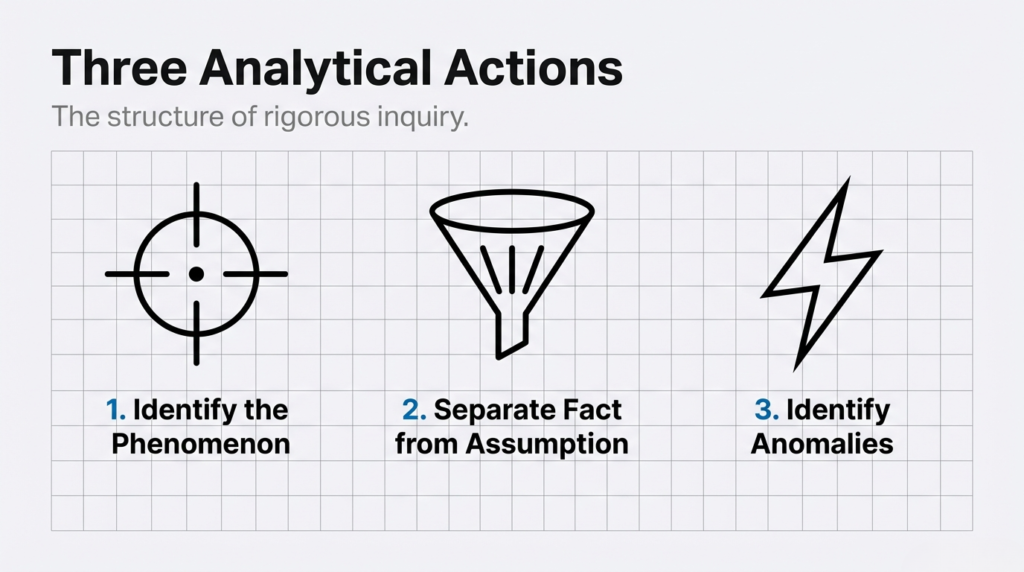
Three analytical actions
The structure of rigorous inquiry is three actions, in order:
- Identify the phenomenon.
- Separate fact from assumption.
- Identify anomalies.
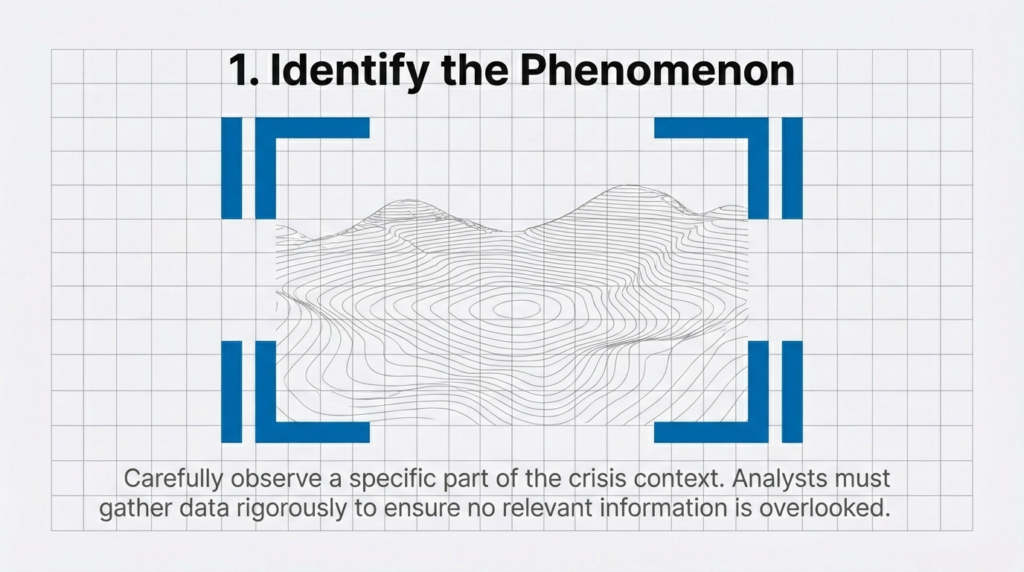
Action 1: Identify the phenomenon
Carefully observe a specific part of the crisis context. Gather data rigorously to ensure no relevant information is overlooked.
In practice, this means narrowing the scope before widening it. A SitRep that tries to cover the entire country in equal depth often produces a vague brief. A SitRep that names the phenomenon — “acute food insecurity in three coastal districts” — gives the analyst a defined boundary to investigate.
- What is the specific phenomenon? Name it precisely.
- Where is it located geographically?
- Over what time period is it happening?
- Who is affected?
- What data sources document it?
Action 2: Separate fact from assumption
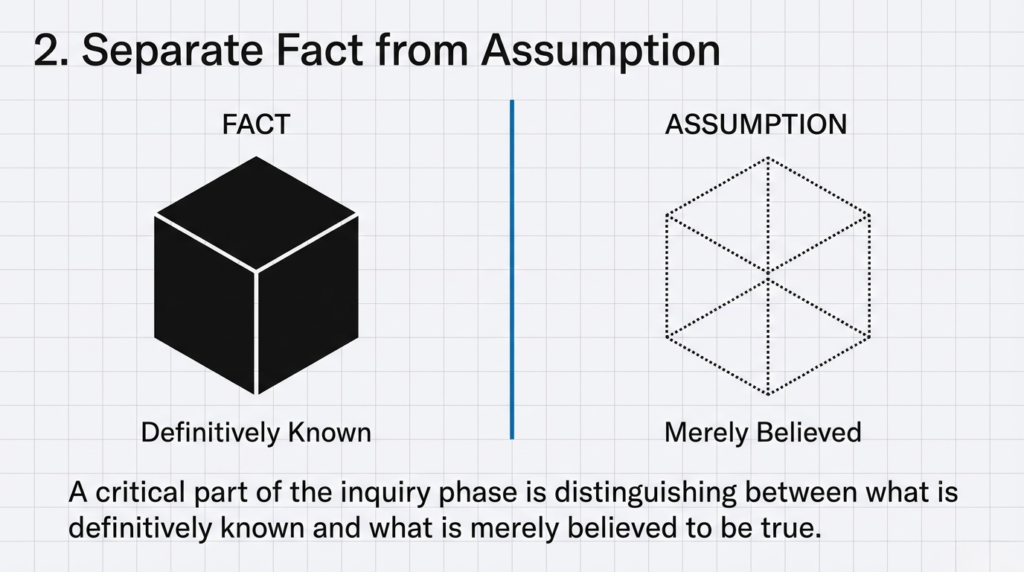
A critical part of the inquiry phase is distinguishing between what is definitively known and what is merely believed to be true.
Fact vs assumption
Fact. Definitively known. Documented in a source you can cite.
Assumption. Merely believed. A statement considered true based on logic that has not yet been tested.
Assumptions are not bad. They are useful working theories. But they should be labeled. A brief that mixes facts and assumptions without distinguishing them gives the reader no way to assess confidence.
Beware the loaded question
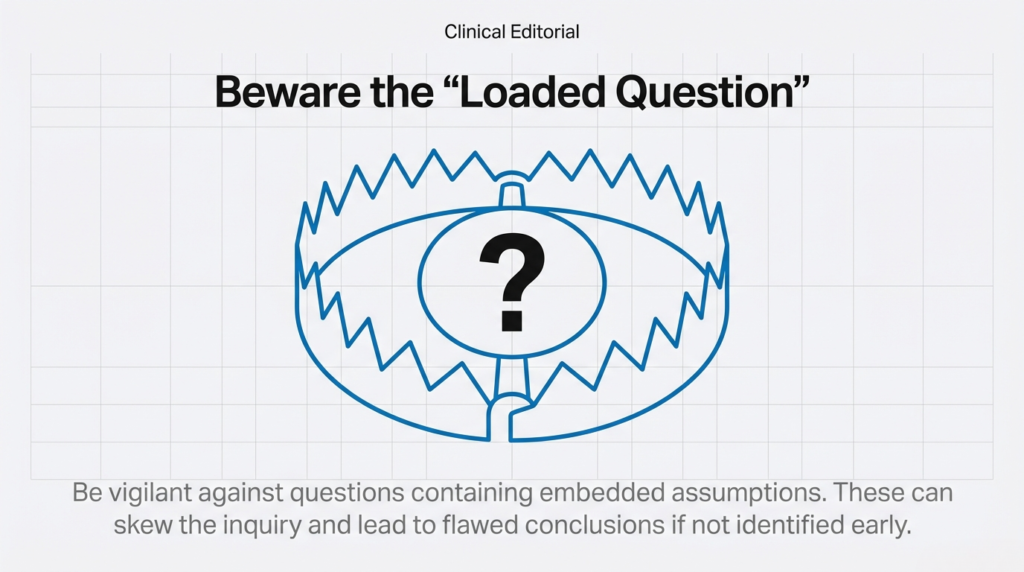
Be vigilant against questions that contain embedded assumptions. These can skew the inquiry and lead to flawed conclusions if not identified early.
- Loaded: “Why is the response in Region X failing?” — assumes it is failing.
- Open: “What is the current coverage and outcome status of the response in Region X?”
The loaded version pre-commits the analyst to a conclusion before the data has been examined. The open version forces the data to speak first.
Action 3: Identify anomalies
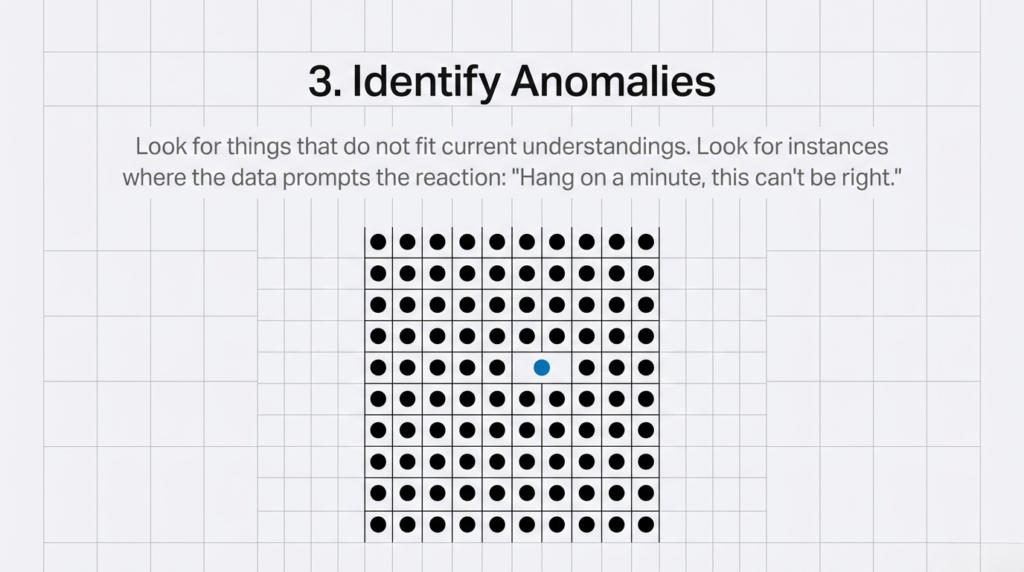
Look for things that do not fit current understandings. Look for instances where the data prompts the reaction: “Hang on a minute, this cannot be right.”
Anomalies — phenomena that contradict accepted knowledge — are valuable. They often point toward the most fruitful areas for investigation.
From the Observation Groundwork guide
Examples of anomalies that often hide important insights:
- A nutrition center reporting admissions that do not match the surrounding cluster data.
- A food security indicator improving in a context where every other indicator is deteriorating.
- A displacement flow into an area that has historically been a sending area, not a receiving area.
- A spike or drop in a routine indicator that has no immediately obvious driver.
Most analysts smooth over anomalies. Strong analysts investigate them. The anomaly is often where the next insight lives.
The groundwork is laid
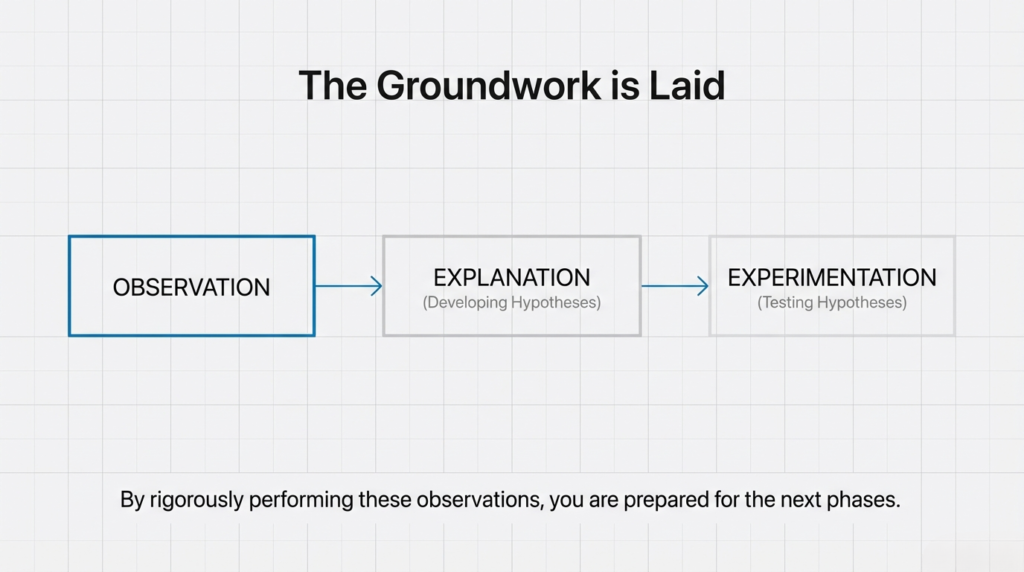
By rigorously performing these three actions, you have prepared the ground for the next phases of the scientific method:
- Observation. You have established the facts. (This phase.)
- Explanation. Now you can develop hypotheses about why.
- Experimentation. Then you can test those hypotheses against evidence.
Without rigorous observation, the next two phases produce confident answers to the wrong question. With rigorous observation, every downstream analytical step has solid ground to build on.
How to apply this in your next analytical task
- Write the phenomenon in one sentence. Specific. Bounded by geography and time. Name the affected population.
- Build a two-column table. Left column: facts you can cite. Right column: assumptions you are making. Mark each assumption with its level of confidence.
- Hunt for anomalies. Scan the data for the moments where you said “that cannot be right”. List them. Investigate the top two.
- Pause before hypothesizing. If you cannot resist the urge to explain, write the explanation in a separate document. Keep the observation document clean.
Continue reading
- The humanitarian scientific method
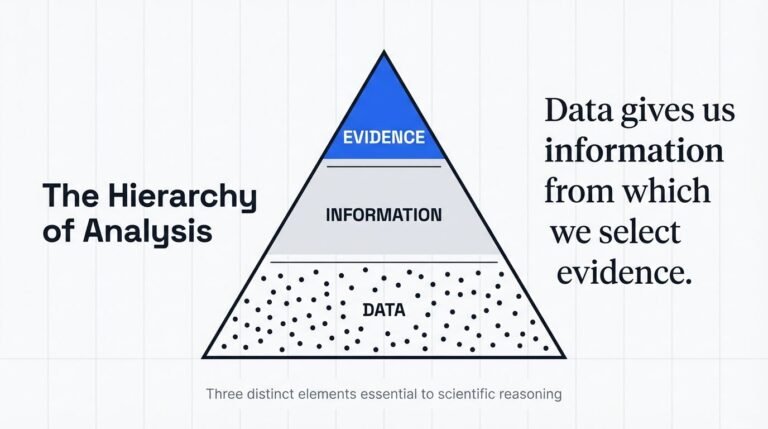
- Data, information, evidence: the architecture of proof
- From evidence to decision: frameworks for humanitarian analysts
Want the full system? The HumGPT course teaches the same workflows on real humanitarian deliverables: SitReps, donor briefs, country risk profiles, secondary data reviews, and more.
$39 (was $197). Lifetime access. 14-day money-back guarantee. Enroll in HumGPT.
Frequently asked questions
What is observation in the humanitarian scientific method?
Observation is the inquiry phase. It establishes a clear and accurate understanding of the facts surrounding a phenomenon before attempting to explain it. It is the first of three phases — observation, explanation, experimentation.
Why separate fact from assumption?
Mixing them in a brief gives the reader no way to assess confidence. Labeling assumptions explicitly allows the reader to weigh the analysis against its uncertainty and decide where to dig deeper before acting.
What is a loaded question?
A question that contains an embedded assumption. “Why is the response failing?” assumes it is failing. “What is the current coverage and outcome status?” lets the data speak first. Loaded questions skew inquiry and produce flawed conclusions.
Why are anomalies valuable?
Anomalies contradict accepted knowledge. They prompt the reaction “hang on, this cannot be right”. They often point to the most fruitful areas for investigation because they signal that something in the accepted understanding is incomplete.
How does observation differ from explanation?
Observation establishes what is happening. Explanation proposes why. The discipline of the scientific method is to complete observation rigorously before moving to explanation. Skipping observation produces confident answers to the wrong question.